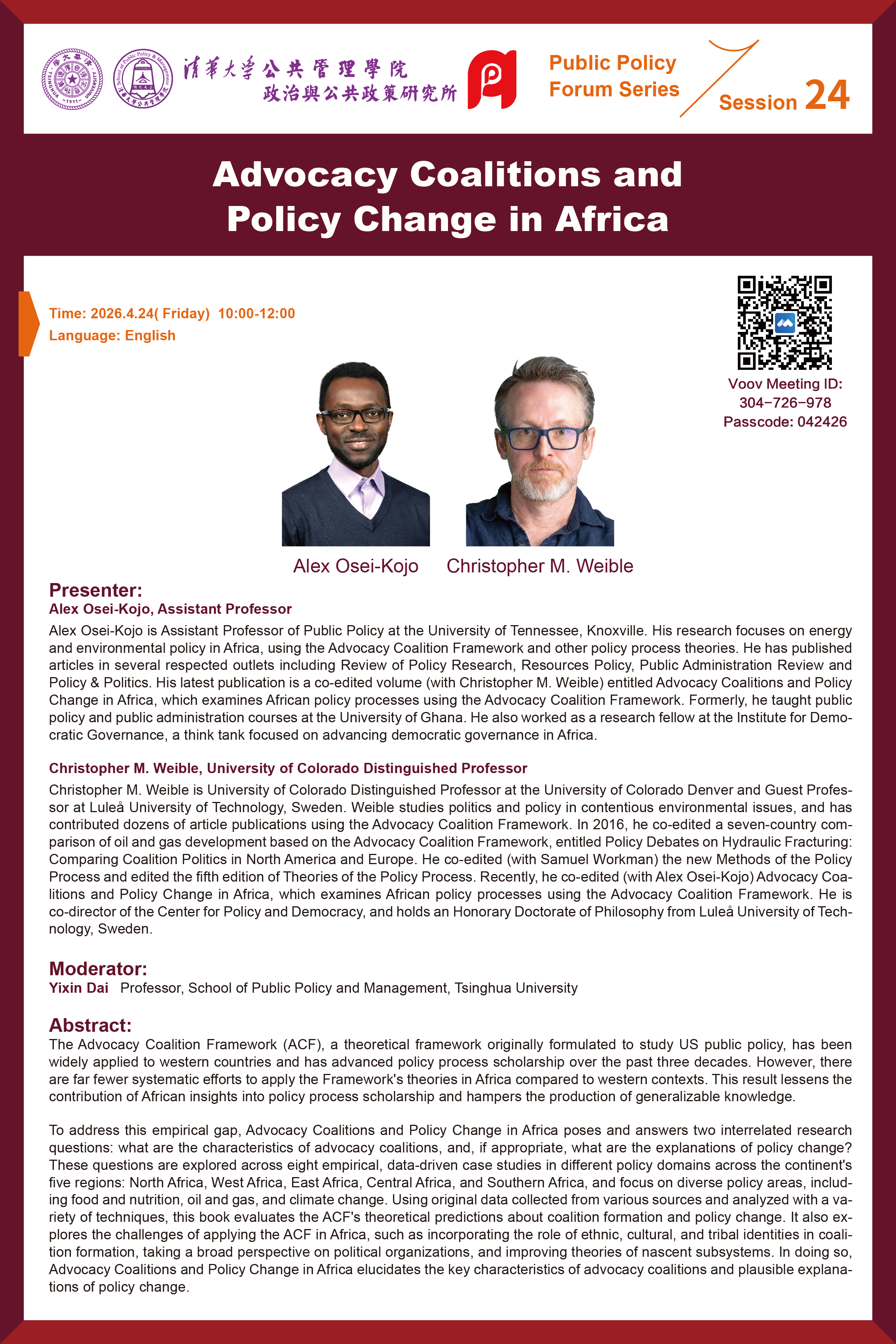
Time: 2026.4.24( Friday) 10:00-12:00
Title:Advocacy Coalitions and Policy Change in Africa
Presenter:
Alex Osei-Kojo, Assistant Professor
Alex Osei-Kojo is Assistant Professor of Public Policy at the University of Tennessee, Knoxville. His research focuses on energy and environmental policy in Africa, using the Advocacy Coalition Framework and other policy process theories. He has published articles in several respected outlets including Review of Policy Research, Resources Policy, Public Administration Review and Policy & Politics. His latest publication is a co-edited volume (with Christopher M. Weible) entitled Advocacy Coalitions and Policy Change in Africa, which examines African policy processes using the Advocacy Coalition Framework. Formerly, he taught public policy and public administration courses at the University of Ghana. He also worked as a research fellow at the Institute for Democratic Governance, a think tank focused on advancing democratic governance in Africa.
Christopher M. Weible, University of Colorado Distinguished Professor
Christopher M. Weible is University of Colorado Distinguished Professor at the University of Colorado Denver and Guest Professor at Luleå University of Technology, Sweden. Weible studies politics and policy in contentious environmental issues, and has contributed dozens of article publications using the Advocacy Coalition Framework. In 2016, he co-edited a seven-country comparison of oil and gas development based on the Advocacy Coalition Framework, entitled Policy Debates on Hydraulic Fracturing: Comparing Coalition Politics in North America and Europe. He co-edited (with Samuel Workman) the new Methods of the Policy Process and edited the fifth edition of Theories of the Policy Process. Recently, he co-edited (with Alex Osei-Kojo) Advocacy Coalitions and Policy Change in Africa, which examines African policy processes using the Advocacy Coalition Framework. He is co-director of the Center for Policy and Democracy, and holds an Honorary Doctorate of Philosophy from Luleå University of Technology, Sweden.
Moderator: Yixin Dai Professor, School of Public Policy and Management, Tsinghua University
Abstract:
The Advocacy Coalition Framework (ACF), a theoretical framework originally formulated to study US public policy, has been widely applied to western countries and has advanced policy process scholarship over the past three decades. However, there are far fewer systematic efforts to apply the Framework's theories in Africa compared to western contexts. This result lessens the contribution of African insights into policy process scholarship and hampers the production of generalizable knowledge.
To address this empirical gap, Advocacy Coalitions and Policy Change in Africa poses and answers two interrelated research questions: what are the characteristics of advocacy coalitions, and, if appropriate, what are the explanations of policy change? These questions are explored across eight empirical, data-driven case studies in different policy domains across the continent's five regions: North Africa, West Africa, East Africa, Central Africa, and Southern Africa, and focus on diverse policy areas, including food and nutrition, oil and gas, and climate change. Using original data collected from various sources and analyzed with a variety of techniques, this book evaluates the ACF's theoretical predictions about coalition formation and policy change. It also explores the challenges of applying the ACF in Africa, such as incorporating the role of ethnic, cultural, and tribal identities in coalition formation, taking a broad perspective on political organizations, and improving theories of nascent subsystems. In doing so, Advocacy Coalitions and Policy Change in Africa elucidates the key characteristics of advocacy coalitions and plausible explanations of policy change.